
Designing Public Spaces for Community Life

Evidence on play, comfort, belonging, and local value
Pouya Zhand RA AIA NCARB
Intemporal Architecture LLC
Abstract
Public spaces give communities opportunities for play, rest, everyday encounters, and shared activity. Counting playgrounds, parks, and trails provides an essential inventory, but it does not reveal whether those places are accessible, comfortable, engaging, or useful to different residents. This article examines public-space quality through childhood development, environmental psychology, social connection, inclusion, outdoor thermal comfort, and municipal economics. It combines the author's graduate thesis and related published work on outdoor comfort with published reviews, experimental and observational studies, and documented projects in the United States.
Evidence supports several pathways to public benefit, particularly opportunities for physical activity, contact with nature, and social interaction. Effects vary by population, context, management, and the outcome measured. A firsthand account of a playground visited in a small European town introduces questions about design and everyday experience. Seven U.S. precedents demonstrate that imaginative, inclusive, and socially useful public places can be built within American institutions. For small towns in Connecticut and elsewhere, an inclusive assessment of existing facilities can guide targeted improvements or a new project where a documented need remains. Success should be assessed through access, experience, observed use, maintenance, and distribution of benefits over time.
What makes a public place worth returning to
During a recent visit to a small town in Europe, my wife and I spent time at a playground that made me think about the public places we have in towns across Connecticut. What stayed with me was how comfortably different activities could happen together. Children had several ways to play and explore, and adults had places to sit and talk.
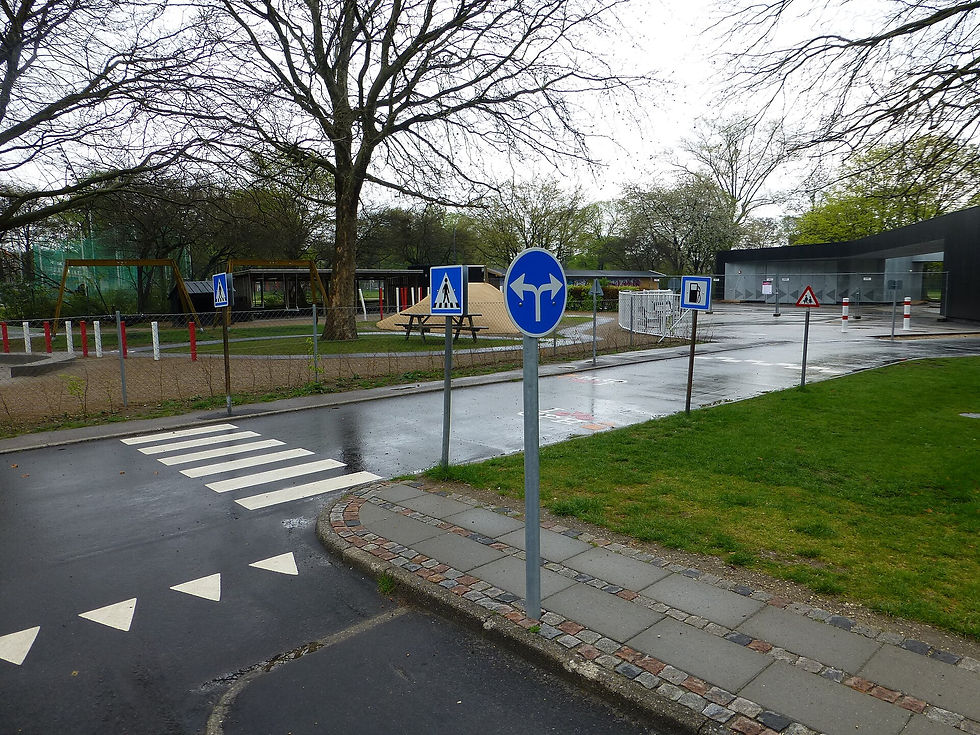
There was engaging sensory play, a sandpit, communal toys and bicycles, and a fabric canopy over part of the playground. A nearby riding path had small traffic signs. Trees surrounded the play areas, and adults could sit on benches and talk. Children repeatedly filled small watering cans from a water tank and watered the trees. These details describe what my family observed during our visit.
The watering cans were especially memorable. Children were doing something with an immediate purpose, using shared objects, and caring for the place around them. The riding path offered a different experience from a general trail: children could participate in a miniature version of public life. Adults had a reason to stay comfortably while children explored. Several activities could happen together, at different speeds, in the same setting.
That experience raises a question relevant to towns of many sizes: what qualities help a public place become part of everyday community life? A town may have several playgrounds and still have gaps in shade, access, activities for particular ages, or places for adults to spend time comfortably. An inventory is a useful starting point. Understanding the experience of a place requires looking at how people use it, who can participate, and what makes them want to return.
Residents will value different opportunities. A trail may offer quiet exercise and contact with nature; a playground may bring families together; a garden or town square may provide somewhere to rest or meet. A useful discussion about public space should recognize what these places already contribute, then examine how their design and care could serve the community more fully.
Evidence and scope
This is a narrative evidence review intended for residents, designers, and municipal decision makers. Research was located through targeted web searches of scholarly publications, PubMed-indexed records, university repositories, and official project documentation on 12-13 October 2026. Search topics included public-space quality, nature play, playground interventions, social connection, inclusion, outdoor comfort, parks and property values, and implemented U.S. projects. The article draws on accessible full texts where available and identifies relevant limitations of studies accessed through abstracts or repository summaries.
The search was selective rather than exhaustive. There was no preregistered protocol, independent duplicate screening, formal risk-of-bias scoring of every study, or new meta-analysis. Published systematic reviews provide broader coverage, while original studies illustrate particular mechanisms and outcomes. Project descriptions document design and implementation; they do not independently establish social, health, or economic effects. The author's travel observations and thesis simulations are identified separately from empirical findings. Family guides contribute firsthand descriptions and help identify examples; official park and design-team records verify the facilities discussed. Applying these findings to a particular community requires an assessment of local conditions and residents' needs.
What the thesis and published research contribute
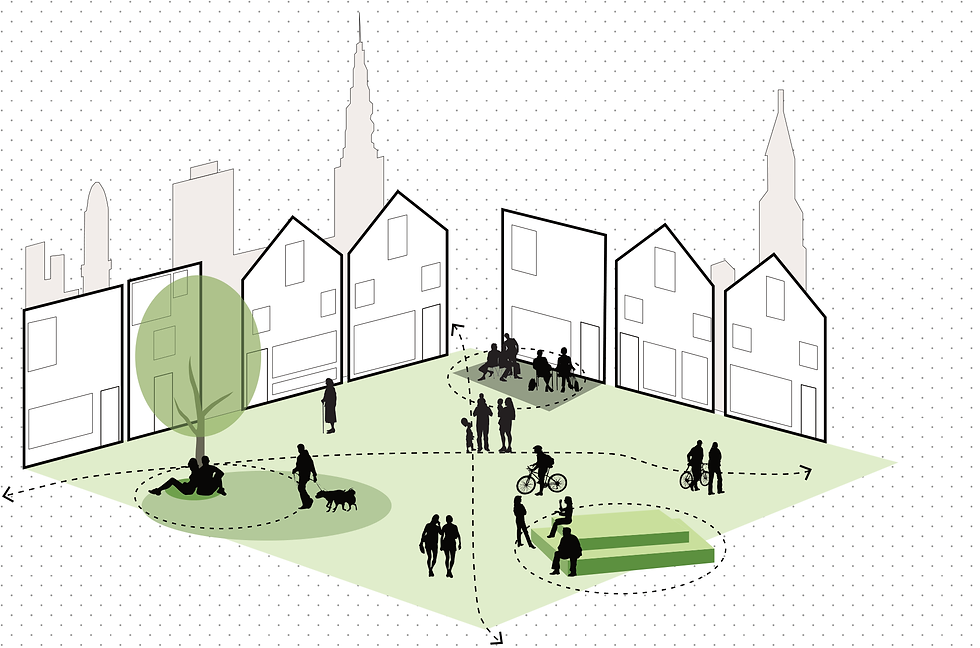
My graduate thesis at Syracuse University, A Simulation-Assisted Workflow for Outdoor Thermal Comfort Design in Downtown Syracuse, completed in 2017, examined how environmental analysis could inform the design of attractive public places. The final presentation identifies Professor Tarek Rakha as advisor and organizes the work into research on public places, outdoor comfort, tool development, and a design case study. The accompanying drafts and presentation notes explain the broader interest in the life that occurs between buildings. [1-4]
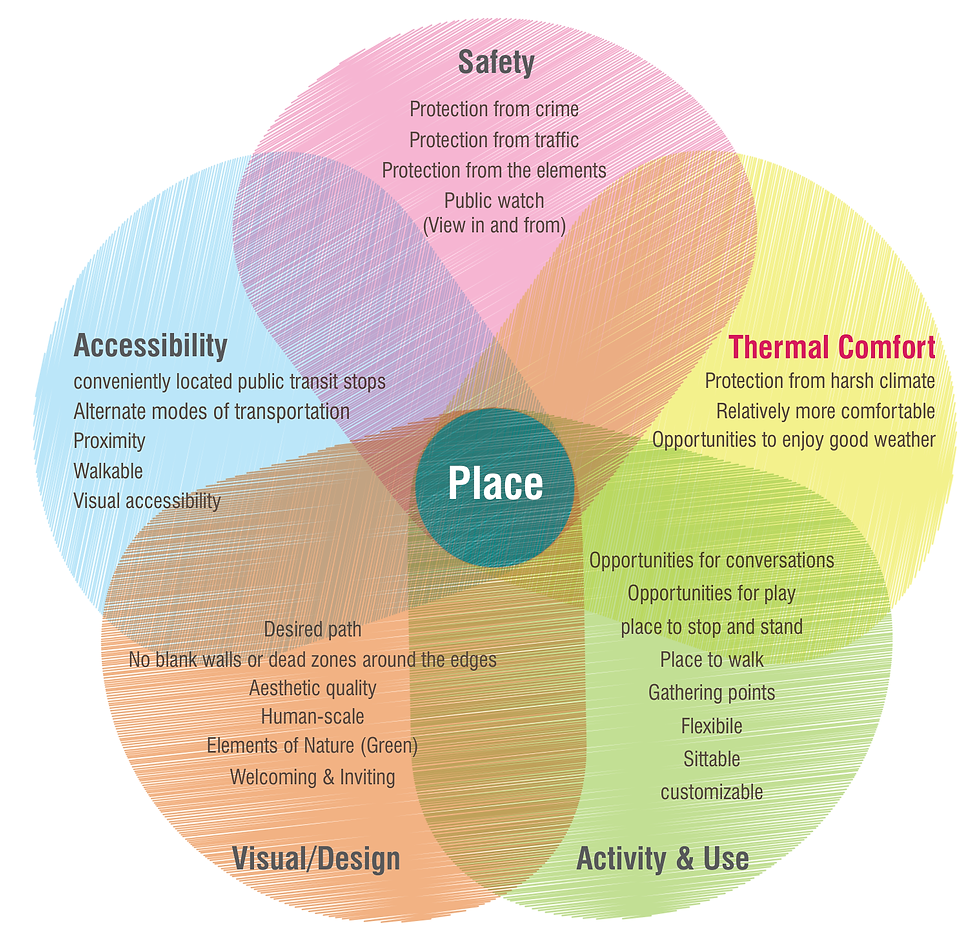
The thesis assembles five interacting dimensions of place: safety, accessibility, visual and spatial design, activities and use, and thermal comfort. Its practical questions are recognizable in ordinary visits to a park. Can people reach the place? Can they see into it? Is there somewhere to sit? Does the layout support conversation and play? Are people protected from traffic and harsh weather? A beautiful object or an impressive building does not answer all of those questions by itself.
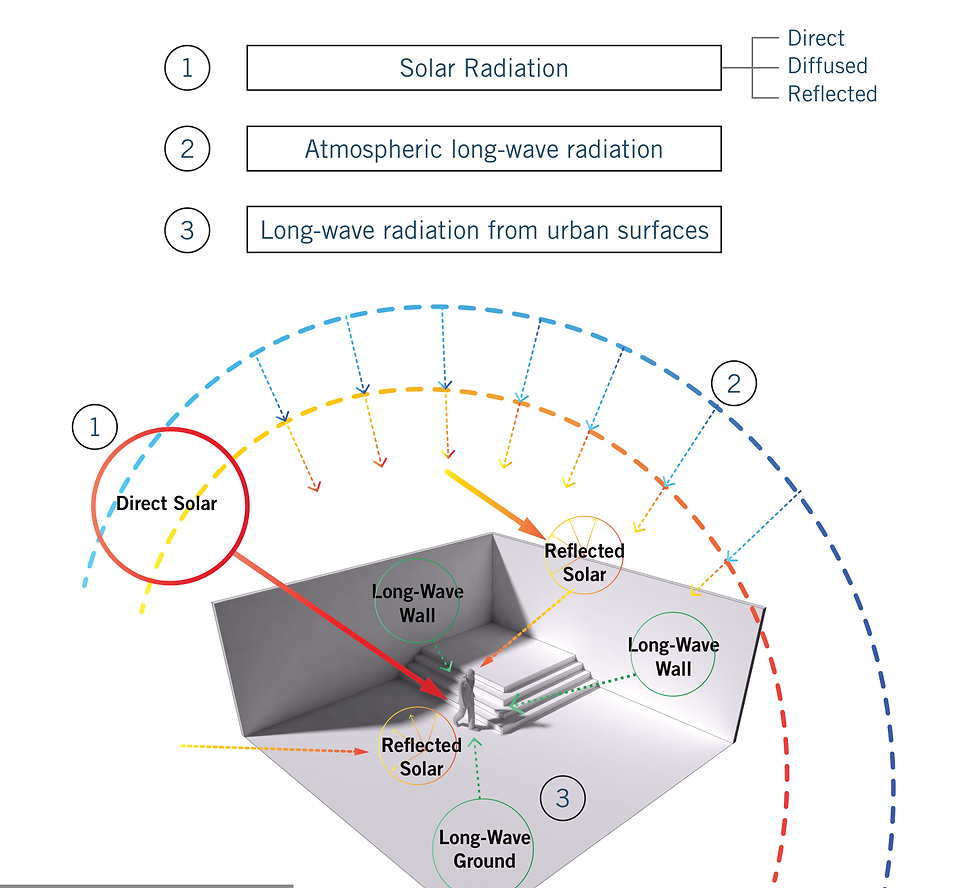
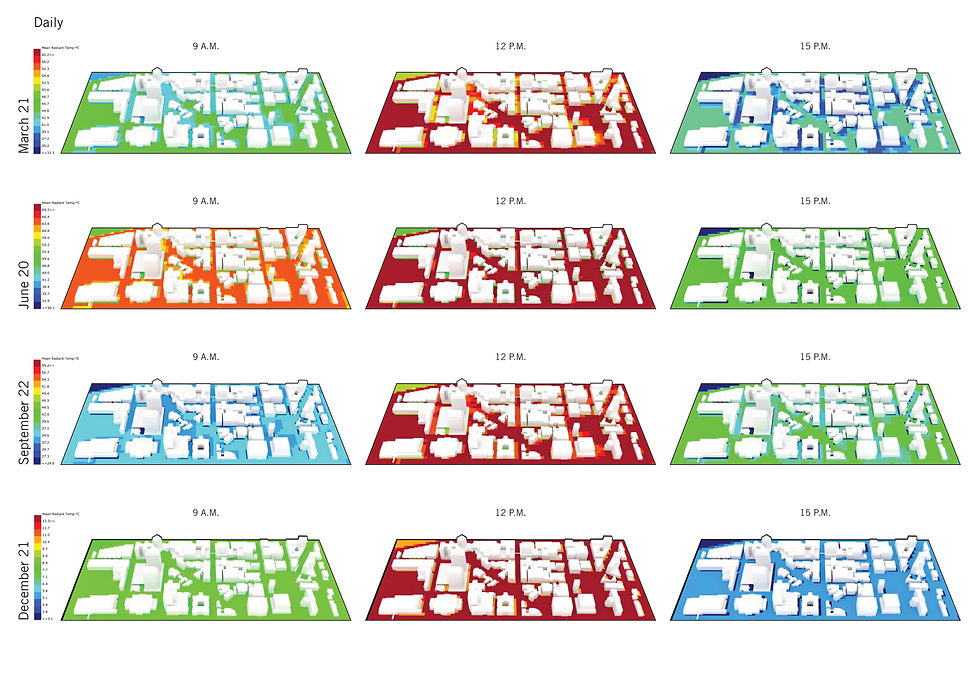
The environmental work used a digital urban model and a computational workflow involving Rhino and Grasshopper, surface-temperature information, and radiation analysis. It explored mean radiant temperature, the combined radiant environment experienced by a person, rather than treating the weather station's air temperature as a complete description of outdoor conditions. Maps and comparisons examined seasonal and daily variation, materials, and alternative forms at a site in downtown Syracuse.
This research also led to a paper I co-authored with Tarek Rakha and Christoph Reinhart, published in the proceedings of Building Simulation 2017. It describes a workflow for mapping outdoor radiant conditions across space and time, demonstrated through a downtown Syracuse case study. The authors identified comparison with measured radiant temperatures and fuller treatment of climatic factors such as wind as necessary next steps. The simulation was presented as a proof of concept. [40]
The final presentation reports that material and footprint had substantial influence within the modeled comparisons. It also reports that passive strategies had seasonal limits in Syracuse and that passive measures alone could not provide sufficient comfort in the colder months. The design proposal combined an outdoor multipurpose place with sheltered or indoor uses, including a public lounge, garden, bicycle service, and food-related activity. It was a speculative architectural proposal, not a constructed project with measured attendance or health outcomes. [1]
The tool assessment is also important. The presentation identifies expertise requirements and issues involving glazing, materials, vegetation, and water. The supplied files do not establish a validated prediction of how many people would use a proposed place, nor do they provide an independently tested estimate of economic benefit. Its strongest contribution to this article is a design method: consider social use and environmental conditions together, compare alternatives, and recognize the limits of the analysis.
For a small-town playground, that approach can begin with simple observations of shade, wind, seating, access, and play patterns, followed by more detailed analysis where it would change a design decision. A town can adapt the method to its own scale and resources. The transfer is a way of asking better questions about everyday experience.
Public space quality and actual use
A public-space inventory answers how many facilities exist and where they are. A quality assessment examines how those facilities work. Both are needed. Quantity can expose an underserved area; quality can reveal that a nearby facility is difficult to enter, has little usable shade, or offers few activities for a particular group.
Nguyen and colleagues' systematic review identified 68 articles from 59 studies on green-space qualities and health. Study designs and definitions varied substantially, with much of the evidence observational. Tree canopy, environmental type, and aspects of size and connectivity were associated with health outcomes in some contexts. The review supports examining particular qualities instead of treating every green area as equivalent, while calling for stronger experimental and longitudinal research. It does not identify one universally optimal park design. [5]
Gehl's Twelve Quality Criteria provide an established observational framework covering protection, comfort, and enjoyment. They draw attention to ordinary conditions such as sitting, seeing, conversation, weather, and the human scale of a space. The tool documentation explicitly describes ratings as subjective; its categories should guide discussion rather than produce a supposedly scientific league table of towns. [6]
Use must also be interpreted carefully. A busy playground may serve many families, but visitor totals alone can obscure who cannot participate. A quiet garden may be valuable precisely because it offers relief from noise. An area used by relatively few residents with particular access needs can still provide substantial public value. Popularity is informative when considered alongside equitable access, the quality of the experience, and the purpose of the place.
Designers can distinguish between reaching a facility, using its features, remaining there comfortably, and returning regularly. Each step presents different barriers. Improving a playground's equipment may achieve little if families cannot find the entrance or arrive during available opening hours. Conversely, an accessible path, a shaded seat, or a nearby toilet may improve the usefulness of equipment that already exists.
Play and childhood development
A wider range of things children can do
The American Academy of Pediatrics' 2018 clinical report on play explains its relevance to social and emotional development, language, self-regulation, and relationships with caregivers and peers. This is a synthesis of developmental research and pediatric guidance, not a trial of a specific municipal playground. It provides a reason to take opportunities for play seriously while leaving the effectiveness of individual design choices to further investigation. [7]
A slide, a sandpit, a shared toy, and a small riding circuit invite different actions. Sand can be moved and reshaped. A toy can be incorporated into an invented story. A circuit can be ridden repeatedly at a child's own pace. These opportunities are sometimes described as affordances: actions made possible by the relationship between a person and an environment. A practical design question is therefore what children can choose to do, rather than how many manufactured components appear in an equipment schedule.
That question should include constructive, imaginative, exploratory, social, and active play. It should also include rest and observation. A toddler may watch older children before joining an activity. A child overwhelmed by sound may seek a quieter edge. A space that supports these transitions offers more ways to participate than one that requires every child to perform the same activity.
Nature play and movable materials
Dankiw and colleagues reviewed 16 studies of unstructured nature play in children aged 2-12. Findings were encouraging for physical activity and imaginative or dramatic play, but the authors emphasized inconsistent definitions, heterogeneous measures, and limitations in study quality. Trees, vegetation, earth, and other natural elements can broaden play possibilities; the review does not justify promising a particular improvement in intelligence, resilience, or mental health from installing a sandpit. [8]
A more specific experiment was the Sydney Playground Project. Twelve schools were randomized, with 226 children aged 5-7 participating in a 13-week study. The intervention combined movable recycled materials with workshops addressing adults' perceptions of risk. Researchers reported approximately 1.8 additional minutes of moderate or vigorous activity during the measured recess period and less sedentary time. Because the materials and adult workshops were combined, their separate contributions cannot be isolated. The result concerns school recess, not an unsupervised town park or all developmental outcomes. [9]
These findings support considering flexible materials alongside fixed equipment. A municipal version could offer a managed collection of appropriate toys, building pieces, or watering cans. It would need an operating plan for storage, cleaning, inspection, replacement, and age suitability. Shared bicycles add further questions about fit, condition, supervision, and protective equipment. The playground we visited offers ideas worth exploring, with operating arrangements suited to the community that would use them.
Riding circuits and the space around them
A small riding circuit serves a different purpose from a long recreational trail. Repeated loops, turns, and pretend road markings can create a setting for practice and imaginative play near caregivers. The ParraParents guide to dinky tracks documents examples around greater Parramatta, Australia, with features such as miniature intersections and traffic signs. Its descriptions also draw attention to practical differences in shade, fencing, and nearby facilities. These are family observations that suggest design questions to investigate locally. [41]
Sydney Park provides a documented municipal example. The City of Sydney lists a children's cycle track with a shaded learn-to-ride area, alongside playgrounds, toilets, seating, and trees. This suggests a useful design relationship: a child can practice riding while the surrounding place supports other parts of a family visit. The park record establishes these facilities; it does not measure how much any one feature improves children's skills or increases attendance. [42]
Activity is an outcome to measure
A 2023 systematic review by Peralta and colleagues included 26 controlled or comparative studies of outdoor park installations and improvements. Eleven of 17 renovation studies reported positive physical-activity results; six did not. Five of nine new-installation studies reported improvements, while four did not. These proportions describe the studies in the review and cannot be used to predict the success of a proposed project. Designs, populations, interventions, and measures varied across studies. [10]
In a San Francisco study, two renovated parks were compared with four other parks. Visitor counts more than doubled relative to parks not yet renovated, with gains concentrated among adults and children rather than teenagers and older people. This illustrates both the possibility of increased use and the need to examine who benefits. It was a comparative observational study, not randomized evidence that every renovation doubles attendance. [11]
The design implication is to specify whose activity or participation a project seeks to improve, then collect appropriate baseline and follow-up information. A riding circuit might be useful for beginning cyclists. It should not be assumed to meet teenagers' needs, accommodate every mobility device, or substitute for safe routes through town. Small traffic signs may support imaginative play and learning opportunities; no evidence reviewed here demonstrates that this particular feature reduces later road injuries.
Challenge with appropriate protection
Brussoni and colleagues' systematic review of 21 studies found generally positive relationships between opportunities for risky outdoor play and outcomes such as physical activity and social behavior, with limitations in the evidence. The relevant distinction is between a challenge a child can perceive and negotiate and an unrecognized hazard. The review does not justify avoidable entrapment, unsafe falls, or exposing children to moving traffic. [36]
For public projects, imaginative play must be paired with suitable equipment, surfacing, inspection, and supervision arrangements. The U.S. Consumer Product Safety Commission's 2025 handbook provides design and maintenance guidance, including age considerations and protection from sun exposure and hot equipment. Safety planning can support a varied play experience when considered from the outset. [32]
Psychology and everyday social life
Environmental experience and mental wellbeing
Some evidence concerns direct changes to environmental conditions. In a Philadelphia cluster randomized trial, 541 vacant lots in 110 clusters were assigned to greening, limited cleanup, or no intervention. Of 442 adults enrolled, 342 had follow-up data. Greening was associated with a 41.5% relative reduction in reporting feeling depressed compared with no intervention, with a wide 95% confidence interval from a 63.6% to a 5.9% reduction. The overall measure of poor mental health did not reach conventional statistical significance. This was neighborhood remediation in a particular urban setting, not a playground trial or evidence that 41.5% of residents were cured of depression. [13]
Other studies examine narrower psychological processes. Bratman and colleagues found that a 90-minute nature walk reduced self-reported rumination and activity in a brain region associated with it compared with an urban walk among healthy participants. This is evidence about a short-term response under study conditions, not proof that a particular landscape prevents mental illness. [14]
Longitudinal research adds another perspective. Alcock and colleagues followed 1,064 people who moved between urban areas using British Household Panel Survey data. Moving to a greener area was associated with better mental-health scores in the three subsequent years. Fixed-effects analysis addressed some sources of confounding, but residential moves were not randomly assigned and greenery was not equivalent to the quality of a playground. [37]
Together, these studies justify taking environmental conditions seriously. They also require specificity. The effects of neighborhood greening, a nature walk, and an engaging play space cannot be treated as interchangeable. A proposed park should identify the experiences it can plausibly provide and evaluate those experiences before making wider health claims.
Familiar faces and opportunities for connection
Sandstrom and Dunn found that interactions with acquaintances were associated with greater happiness and feelings of belonging in studies of everyday social contact. The research concerns weak social ties rather than park design. It supports the possibility that ordinary encounters matter, without establishing that benches alone reduce loneliness. [15]
Jennings and Bamkole's review discusses social cohesion as a potential pathway linking urban green space and health. Opportunities to gather and shared experiences may support connection, but social processes depend on who feels welcome and how a place is used. A landscaped setting can also remain socially divided or feel exclusionary. [16]
Seating arrangements can make casual contact easier. A parent may greet someone seen repeatedly at the same time of day. A grandparent may talk with another visitor while children play. A person attending a library activity may spend a few minutes outdoors afterward. These are plausible mechanisms for repeated contact, not guaranteed outcomes. A thoughtful layout can make participation possible while retaining space for people who prefer solitude.
The Knight Foundation and Gallup's Soul of the Community study, conducted across 26 U.S. communities over three years, identified social offerings, openness, and aesthetics among the strongest correlates of community attachment. It also reported a relationship between attachment and local economic growth. Those associations do not show that a playground causes GDP growth, and the surveyed communities are not a representative experiment on all American towns. Their contribution is to show that residents' connection to a place includes qualities beyond basic service provision. [17]
Taking part in the care of a place
The watering activity we observed suggested a small form of participation: children could contribute to something visible and shared. It is reasonable to explore such experiences as opportunities for agency, cooperation, and learning. A single visit cannot establish lasting environmental attitudes or community trust.
Ardoin and Bowers' systematic review of early childhood environmental education examined 66 studies and described varied developmental and environmental-learning outcomes. Many programs used play, movement, social interaction, and nature-rich experiences. These findings concern educational programs with different methods and contexts; they are not evidence that an unattended water tank produces the same outcomes. [38]
A local interpretation could involve supervised watering, a community garden activity, or seasonal planting organized with the library or recreation department. The design and the program would work together. Care tasks should remain voluntary, suitable for the participants, and compatible with the town's maintenance responsibilities.
Inclusion across ages and abilities
A public place should accommodate residents whose needs differ from those of its most visible users. Relevant questions include mobility, sensory experience, available time, transport, cost, and whether a person feels welcome. Families should not have to buy food, book a class, or own expensive equipment simply to spend time in an ordinary public place.
Brown and colleagues' scoping review synthesized 35 studies on inclusive playground design. Recommendations addressed entrances, surfacing and paths, play features, staffing or supervision, and the design process. The findings highlight the importance of involving children with disabilities and caregivers rather than treating inclusion solely as an equipment specification. Much of the underlying literature used case studies and observational methods; it is guidance informed by evidence, not a guaranteed formula for social inclusion. [18]
The ADA standards contain scoping and technical requirements for play areas, including accessible routes and play components. Those obligations establish a necessary design baseline. A broader assessment should also ask whether children can play with one another, whether caregivers can approach and assist, and whether activities offer different ways to participate. Requirements must be evaluated for the actual site and project rather than inferred from a photograph. [19]
For early design, useful questions include whether entrances create unnecessary barriers, whether ground-level activities offer meaningful play, and whether a quieter space is available near busier activity. The layout should allow different experiences without isolating children by ability. Families and relevant professionals can test a concept before equipment is selected.
Adults' needs deserve comparable attention. The World Health Organization's guidance on age-friendly communities identifies accessible infrastructure, public seating, and sanitary facilities among conditions supporting participation across ages and capacities. In a park, a route to a comfortable seat can make a visit practical for an older resident or caregiver as well as for a child. [33]
Inclusion therefore concerns the entire visit: arriving, entering, participating, resting, using necessary facilities, and leaving. This perspective can reveal inexpensive changes to an existing place as well as reasons for a larger project.
Outdoor comfort and environmental design
Shade is part of usability
My thesis placed thermal comfort within the larger experience of public space. An exposed seat can exist on a plan yet be unattractive on a hot afternoon. A shaded play area may invite a longer visit, while the same location may benefit from sun during cooler months. These are conditions to observe rather than assumptions to apply uniformly.
A designer could use the published method to compare radiant conditions at proposed seating locations and different times of day, informing decisions about where shade would be most useful. [40]
Outdoor comfort depends on air temperature, radiation from the sun and surrounding surfaces, wind, humidity, clothing, activity, and personal responses. Mean radiant temperature helps describe radiant exposure; it is not the same as air temperature. A forecast alone cannot characterize the difference between an exposed paved area and a nearby shaded seat. The thesis's radiation diagram illustrates why surrounding materials and geometry matter. [1,4]
Nikolopoulou and Steemers' research on outdoor comfort emphasizes psychological adaptation as well as microclimate, including expectations, experience, perceived control, and duration of exposure. This supports offering choices between conditions rather than seeking one identical environment for every user. It does not establish that physical discomfort can be solved through attitude alone. [20]
Trees can also affect local conditions. Ziter and colleagues measured summer air temperatures across Madison, Wisconsin, and found cooling associated with canopy cover, with effects dependent on spatial scale and surrounding impervious surfaces. This is field evidence about urban air temperature. Applying it to a new tree planting requires attention to species, growth time, weather, and site conditions; the study cannot supply a guaranteed temperature reduction for every site. [21]
Design for Connecticut seasons
For a Connecticut project, an initial study could map where shade falls during expected hours of use in summer, spring, and autumn. It could identify exposed seating, glare, prevailing wind, wet areas, and routes that become difficult in winter. The assessment should consider caregivers who may sit for long periods as well as children who are active and move between settings.
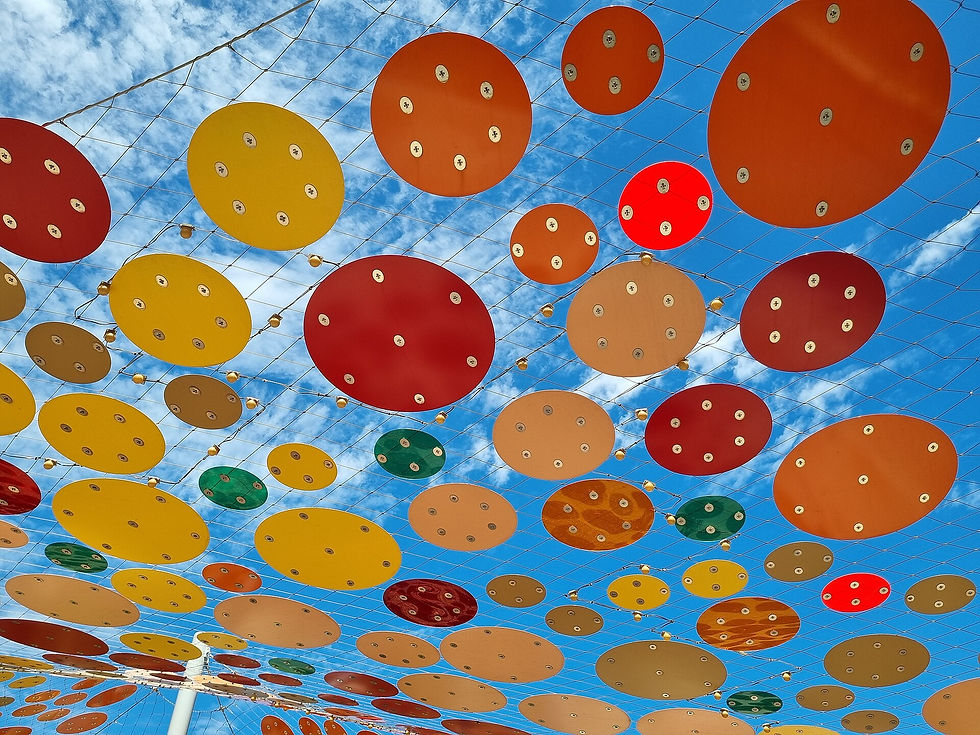
A canopy can provide shade before planted trees mature. Deciduous trees can offer seasonal variation where species and siting are appropriate. A sunny bench and a sheltered bench may serve different preferences on the same day. Rain protection, wind shelter, and drainage can extend practical use, subject to cost and maintenance. These are design options to test against the site and community's priorities, not a claim that every park needs every feature.
The CPSC handbook specifically notes that direct sun can heat equipment and surfacing enough to cause burns, even in mild weather, and discusses shade strategies. It also notes maintenance implications of trees. Shade therefore has implications for both the visitor's experience and the operation of the playground. [32]
Where decisions justify further analysis, tools such as the Universal Thermal Climate Index integrate weather variables using a physiological model. Such indices are useful for comparing environmental exposure under defined assumptions. They should not be treated as individualized measures of a toddler's health, a resident's satisfaction, or actual attendance. Model results should be checked against site conditions and people's experiences. [22]
Ecology and public experience
Planting, soil, and drainage should be considered together with human use. A plan can protect existing trees, give new trees adequate growing space, manage runoff, and place vigorous activity where it will not continually damage sensitive areas. These choices have site-specific implications for maintenance and environmental performance. Planting is not automatically successful simply because it appears green in a rendering.
Children's interaction with plants can become part of the experience when designed and managed appropriately. A small care activity, like the watering we observed during our visit, should follow an actual horticultural plan. Water storage requires decisions about source, cleanliness, access, drainage, and seasonal shutdown. A task that appears simple to a visitor often relies on ongoing work by staff or volunteers.
Economics and municipal value
Benefits reach beyond the equipment
Public-space investment can create several kinds of value: opportunities for recreation, a more useful community setting, environmental services, and potential benefits to nearby businesses or property. These outcomes should be evaluated separately. A town can value a playground as a public service even when a direct cash return is small or uncertain.
Crompton and Nicholls' review of 33 U.S. studies found that proximity to parks was generally associated with higher house values, with variation by park size, distance, and type. Passive parks often showed greater premiums than active parks, and immediately adjacent properties did not always have the largest premium. These variations make local context essential when assessing potential property-value effects. [23]
Property values, household wealth, municipal tax receipts, and net public benefit are different quantities. Changes in assessments and tax policy affect revenue. Increased values may also raise costs for renters or prospective buyers. Construction spending can support suppliers and workers, but gross spending is not the same as net local economic gain. Money spent by an existing resident may have been spent elsewhere locally without the project.
A welcoming place near existing services may give visitors a reason to combine activities and patronize nearby businesses. This is a plausible local mechanism to investigate through visitor surveys or business data. Estimating additional retail spending would require evidence about location, connections, operating hours, and the actual pattern of visits.
Likewise, health-related economic benefits require a chain of evidence: the project changes behavior, the behavior affects health, and the health change affects costs. Broad estimates of the economic value of physical activity cannot simply be assigned to a local playground. Benefits may accrue to residents, employers, insurers, or healthcare systems rather than to the town's budget. A credible municipal case should state who is expected to benefit and how.
Cost over the whole life of the place
The initial purchase is only one part of cost. A budget should address design, site work, accessible routes, equipment and surfacing, installation, planting, utilities where needed, inspection, insurance implications, routine care, and later replacement. Shared play materials, programming, and public facilities add operating responsibilities. Donation of design time or volunteer effort can reduce some cash expenditure while still requiring coordination and qualified work.
For illustration only, suppose a project has a $250,000 initial cost, $10,000 in annual operating costs for twenty years, and a $50,000 renewal in year ten. Its undiscounted total would be $500,000, before inflation and other omitted costs. At 10,000 visits each year, that equals $2.50 per visit over twenty years; at 5,000 visits, $5.00. These hypothetical inputs illustrate sensitivity to use and maintenance; they are not a budget estimate for an actual project. A formal appraisal would also consider discounting, residual value, funding timing, and benefits that visitor counts do not capture.
This makes the operating plan part of the design brief. A town should know who inspects equipment, maintains surfacing, looks after trees, opens or closes facilities, and replaces shared items. Volunteers can supplement those functions, but a project dependent on one family's continuing availability is vulnerable. Reliable public care should survive changes in staff and volunteers.
Equity belongs in the economic assessment
Anguelovski and colleagues examined greening and gentrification across 28 cities in nine countries and found relevant positive relationships in 17 cities during at least one studied decade. The work concerns larger urban settings, so applying it to small-town projects requires caution. It nevertheless illustrates why rising property values should not be treated as an unqualified public benefit. Access, affordability, and the distribution of gains deserve attention alongside investment. [24]
For any community, practical questions include who can reach the site, whether use remains free, whether improvements address an overlooked need, and whether costs impose unreasonable burdens. Comparing a modest upgrade with a new facility may reveal a better use of public resources. A project should earn support through documented usefulness and feasible stewardship.
What can be learned from Europe
The playground we visited suggests specific design and operating choices worth discussing. A single visit provides inspiration and questions to investigate, while a broader comparison requires evidence from many places. Countries, towns, neighborhoods, climates, budgets, and management arrangements vary substantially within both Europe and the United States.
Comparative transport research by Pucher and Buehler describes how cycling in the Netherlands, Denmark, and Germany is supported by coordinated infrastructure, traffic calming, land-use policy, education, and other measures. Their 2008 analysis concerns transport rather than playgrounds, but it illustrates how everyday behavior can be shaped by public systems as well as individual preferences. Its historical trip shares should be understood in the period studied. [25]
For a public-space comparison, relevant questions would include settlement pattern, safe access, proximity to daily activities, available facilities, funding, maintenance, and residents' expectations. A compact neighborhood and a dispersed rural community may need different arrangements. A visitor's impression is a good source of questions; systematic observation and local evidence are needed to assess the answers.
American examples also show that imaginative play, shade, social seating, and shared experiences are compatible with U.S. institutions. Learning from another place can mean adapting a small useful feature, such as a shaded conversation area or a managed toy collection, rather than importing an entire model. It can also mean improving a place residents already value.
Seven implemented United States precedents
These projects are precedents for design and delivery. Their inclusion does not imply that independently measured health or economic gains are available for each one, or that a small town should copy their scale.
Newtown Connecticut Bicycle Playground
American Ramp Company's project record identifies a built bicycle playground in Newtown, Connecticut. It is a relevant local example of a designated cycling environment with purpose-built riding elements, rather than a general path alone. The manufacturer's project record verifies the type of facility; it does not measure learning, safety, or community cohesion. [30]
For a town considering similar opportunities, the transferable idea is to identify a specific activity and its users, then consider whether an existing site could support it. A circuit for beginning riders would need its own assessment of access, circulation, maintenance, and separation from incompatible activity. It could complement playgrounds and trails already serving other purposes.
Berkeley California Adventure Playground
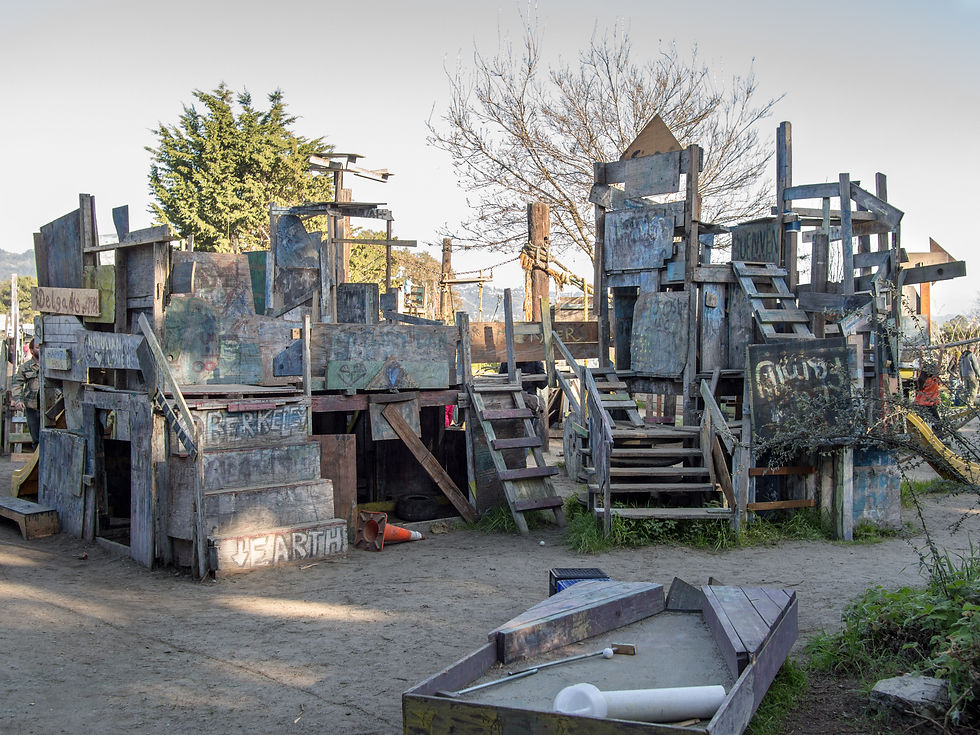
Berkeley's municipal Adventure Playground opened in 1979 and provides a model in which children can help create the play environment. The city's description includes child-built structures, recycled materials, painting, and tools, with adult supervision requirements. Individual and family admission is free during regular hours. The city also manages the kinds of donated materials it accepts. [26]
The lesson is that participation and movable materials are possible in an American public setting, accompanied by operating rules and responsibility. A small town could adapt an appropriately scaled activity with qualified supervision. The photograph documents a particular place and date; it should not be interpreted as a standard construction specification for a new playground.
Tulsa Oklahoma Gathering Place
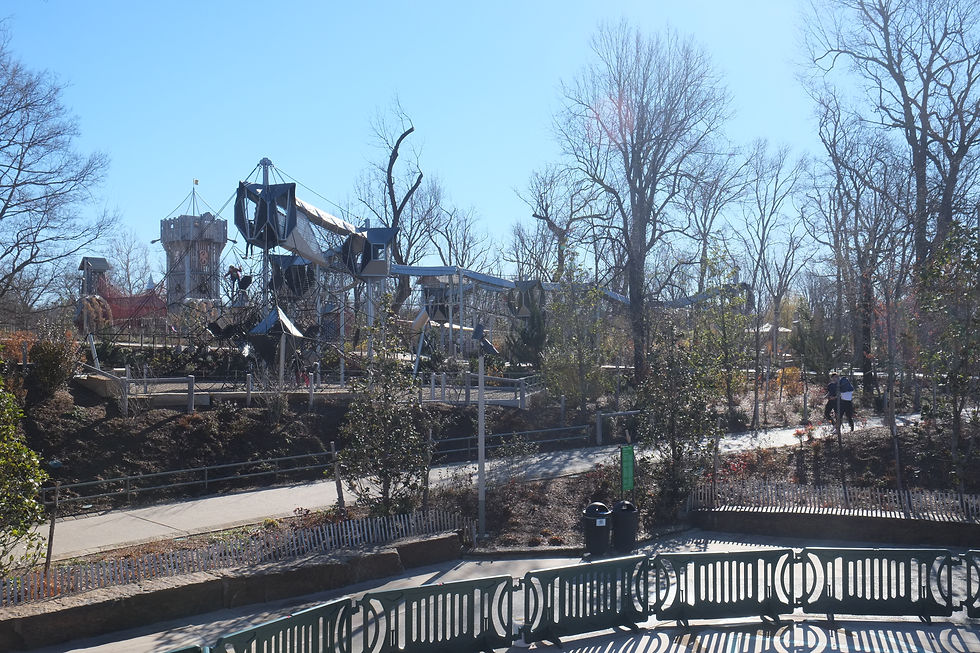
Gathering Place combines gardens, paths, play areas, aquatic features, and free cultural and educational activities. The George Kaiser Family Foundation describes its opening in September 2018 and its role as a public destination with no-cost access to the listed attractions and programming. Its philanthropic origins and substantial scale distinguish its delivery model from a small municipal playground. [27]
Its relevance is the relationship among uses. Families can play, sit, explore, and attend activities within a connected setting. The principle can be considered at smaller scale: group complementary experiences so different residents have reasons to visit and remain. The foundation's description is a project account, not independent evidence of a specified economic return.
Philadelphia Pennsylvania Anna C Verna Playground
Studio Ludo's project description documents a two-acre playground completed in fall 2023 at FDR Park. The design brings play into existing tree canopy and includes shaded seating, an accessible perimeter path, planting, a picnic pavilion, and stormwater strategies. These features demonstrate how play, rest, access, and environmental design can be considered together. [28]
The transferable lesson is coordination across the whole setting. A circulation or planting decision can serve more than one purpose. The designer's account documents intent and built features; it does not establish that those features independently increased social connection or produced a financial return. A small town can learn from these principles while developing a budget appropriate to its own site and scale.
Boston Massachusetts City Hall Plaza
The author's thesis used the earlier Boston City Hall Plaza as an example in a discussion of public-space shortcomings. Boston subsequently completed a renovation in November 2022. The city's project documentation describes accessible connections, shady seating and gathering areas, play space, event infrastructure, new trees, and increased permeable surfaces. [1,29]
This is a useful reminder to examine current conditions before judging a place from an old photograph. It also demonstrates an upgrade to an existing civic space, integrating children's play into a setting used by a broader public. A town's improvement strategy can similarly build on existing land and identity, even when its scale and resources are much smaller.
Rockford Minnesota Lake Rebecca Park Reserve
The We Found Adventure account of three family biking parks describes visits that combined cycling, picnicking, and playground stops. At Lake Rebecca Park Reserve, the family noticed hidden animals and tracks incorporated into the play area. This account helps explain why the experience of a visit can depend on more than a trail's length. It describes one family's outing rather than representative visitor research. [43]
Three Rivers Park District independently documents an 8.1-mile paved biking route, a Big Woods-themed play area, and picnic facilities at Lake Rebecca. These are complementary opportunities within a regional reserve. The small-town lesson is to consider connections and useful stopping places when evaluating a trail or playground. An extensive regional route has different demands from a beginner's riding loop; distance, gradients, crossings, and rider ability require their own assessment. [44]
Baltimore Maryland Rash Field Park
The Sunshine Whispers playground guide identifies Rash Field Park among a range of Maryland examples. Its selections reflect the author's family experience and preferences, offering places to investigate rather than a scientific ranking of playground quality. [45]
The Natural Learning Initiative at North Carolina State University documents its work with Mahan Rykiel Associates and Waterfront Partnership on two contrasting play areas at Rash Field, opened in November 2021. One incorporates digging, sand, water, mounds, native planting, and shade trees; the other offers more intense climbing and movement through towers and elevated connections. [46]
The transferable idea is a range of experiences: active climbing, material play, exploration, and places to pause can coexist within a larger landscape. A town can consider that range at an appropriate scale. These project descriptions establish built design features and professional intent; evaluating their effects on use or wellbeing would require separate evidence.
A practical approach for small towns
Begin with the places already there
Begin with an inventory of existing public places. Confirm each site's ownership, access rules, opening times, facilities, connections, condition, and current plans. Include playgrounds, trails, fields, gardens, civic spaces, and other places residents use. The assessment should examine both what is available and how practical it is for different people to use it.
Involve the officials and staff responsible for recreation, planning, public works, and maintenance, alongside the library, schools where appropriate, and residents. Establish who owns and manages each site and which approvals a proposed change would require. Decisions concerning any school site should also account for school operations and public access.
An assessment should ask what existing places do well. A trail may provide quiet exercise and contact with nature. A field may serve organized activity. A school playground may offer valuable equipment with particular hours or rules. The aim is to understand the network of opportunities, then locate gaps that matter to residents.
Ask people who use the places and people who do not
A short survey can ask where residents go, how they travel, what they value, and what makes a visit difficult. Include caregivers, young people, older residents, people with disabilities, and neighbors of potential sites. Offer different ways to contribute, including options for residents who rarely attend public meetings. Children can communicate through drawings, walks, or demonstrations as well as questionnaires.
Questions should leave room for different priorities. Some people may prefer a quiet place or improved access to a current trail. Others may want shade, suitable toddler activities, a cycling circuit, or better opportunities to sit. Residents concerned about cost should be invited to help compare choices. Community engagement should be capable of changing the proposal.
Compare an upgrade with a new project
At least three options deserve consideration: improving one existing place, connecting or coordinating existing places, and building a new facility if a significant need remains. An upgrade might add shade, seating, planting, circulation, or a distinct play experience. A connection might link a playground to an established walking route or community activity. A new site could be justified by a location or access gap that other options cannot reasonably address.
Each option should be compared using the same questions: which need it meets, whom it serves, how people reach it, what it costs initially and annually, and who will care for it. This makes modest improvements visible as legitimate possibilities and makes the case for a larger proposal easier to assess when one is warranted.
Test a manageable change
A small authorized pilot can help reveal demand and operational issues before a larger commitment. Examples might include a seasonal supervised nature-care session, temporary shaded seating, or a managed play-material collection. Any physical installation or activity would need the relevant town review and suitable arrangements for access and safety. A pilot should have a defined duration, responsible operator, and method of evaluation.
Public play equipment and surfaces require proper design and installation; a temporary demonstration does not substitute for that work. Community volunteers can contribute where appropriate to approved tasks, planting, events, or construction under qualified direction. Their effort should complement a durable town operating plan.
Match funding to a public purpose
Connecticut's Small Town Economic Assistance Program funds eligible municipal capital projects, and only eligible municipalities can apply. The program page checked for this review states that no application round is currently open. The 2025 guidelines preferred, but did not require, a 20% municipal contribution to the total project. Future terms and deadlines must be checked when a new round is announced. [34]
A relevant precedent is the state's 2025 award of $892,888.10 for playground improvements in Ledyard, matched by $179,000 from that town. The award demonstrates that playground investment can fit a municipal funding program. A new proposal would still need to meet the eligibility, application, and funding conditions in effect at the time. [35]
A credible proposal would combine a documented need, town support, site suitability, a realistic scope, and an operating commitment. Donated professional time and community participation may help move it forward. They should be described as contributions to a public project, with clear responsibilities, rather than as a substitute for all professional services or municipal oversight.
Measuring results and sustaining the place
Establish a baseline and return to it
The System for Observing Play and Recreation in Communities, or SOPARC, was developed to assess park users and activity through structured observations. It offers a research basis for observing use rather than relying only on impressions. A small-town evaluation can adapt the principle with trained observers, consistent times, and clearly defined measures. A simplified local count should not be represented as a validated SOPARC study unless its protocol is actually followed. [31]
Useful baseline observations would cover multiple weekdays and weekends, relevant seasons, and times of day. Record weather, school schedules, special events, and whether facilities are operating normally. Repeat comparable observations after changes. Where feasible, an unchanged comparison site can help distinguish project effects from changes affecting all local parks.
The evaluation should consider visits, duration of stay, kinds of play, use of seating, accessibility barriers, and users' reported experiences. Physical activity is one outcome among several. A quiet seated conversation may be a successful use of public space even though it contributes little vigorous activity. Satisfaction surveys should include people who stopped visiting or have never been able to use the place.
The following indicators are proposed for a local evaluation. They are not a validated composite score and should be selected with residents and staff.
Dimension | Suggested indicator | Question it helps answer |
Access | Routes, entrances, opening hours, reported barriers | Can residents actually use the place? |
Play | Types of activity and repeated participation | Does the setting offer varied, useful experiences? |
Comfort | Use of shade and seats, weather, reported comfort | What conditions help people remain? |
Social experience | Conversations, shared activities, reported welcome | Does the place support the contact residents want? |
Inclusion | Feedback from underserved users and nonusers | Whose needs still receive inadequate attention? |
Stewardship | Condition, repair response, replacement and staff effort | Can the town sustain what it provides? |
Cost | Capital and operating costs, visits and service objectives | Is the investment proportionate to its public purpose? |
Aggregate observations do not reveal every person's motivation, disability, or sense of belonging. Self-reports and direct participation add information, but they bring their own selection and response biases. The objective is a more informed local decision, not an exaggerated claim of experimental certainty.
Management can change the outcome
A Los Angeles randomized trial involving 50 parks combined feedback on use, outreach and marketing training, and $4,000 per intervention park for activity-related improvements. Intervention parks showed greater use and activity relative to controls. Involving park advisory boards did not produce a clear additional advantage over working with park directors alone. The result supports a package of management actions; it does not isolate community engagement as the sole cause. [12]
Earlier Los Angeles research found declining use after improvements when programming also decreased, reinforcing that a capital upgrade need not produce sustained gains by itself. Facilities, staffing, access, and activities interact. [39]
A town's operating plan could identify who checks shared items, maintains shade structures and planting, handles complaints, and communicates changes. Programming should be optional and appropriate to local demand. The place should also remain useful when no organized event is occurring.
Over time, observations can guide changes: a bench may need to move, a shaded area may be too small, a popular activity may create conflicts, or a quieter option may be missing. A public place is maintained and adjusted through use. The cycle from design to experience, feedback, and care is a practical management process. Wider health and economic effects should be investigated with appropriate methods rather than assumed from higher attendance.
Conclusions
The evidence supports a serious discussion about the quality of the places communities share. Play opportunities, access to nature, comfortable outdoor conditions, and everyday social contact have distinct research foundations. Their benefits are neither identical nor automatic, and local design choices must be evaluated within the community that will use and maintain them.
The European playground is valuable as a detailed observation of an experience that worked well for one visiting family. The U.S. precedents demonstrate that similarly thoughtful approaches are possible here through different combinations of municipal action, professional design, philanthropy, and participation. Each offers transferable ideas while also showing why operating arrangements and local context matter.
For small towns in Connecticut and across the United States, a useful next step is to recognize existing assets, listen broadly, and identify a specific opportunity to improve public life. That opportunity may be an upgrade, a better connection, a new activity, or a new facility. A responsible proposal should explain its purpose, cost, access, and stewardship, then return to the community with evidence about how it works.
My graduate thesis approached public space through the relationship between people, activities, and environmental conditions. A visit to a playground brings those questions into everyday life: where people sit, how children explore, and what makes it comfortable to stay. Designing with that experience in mind can help a community make better use of the places it shares, then learn from how they work over time.
References
The following list distinguishes the author's source materials, scholarly research, and implementation or policy records. Web records were checked on 12-13 October 2026. Numbered citations identify supporting sources; project records establish features and delivery rather than independently measured benefits.
1. Zhand P. 2017. A Simulation-Assisted Workflow for Outdoor Thermal Comfort Design in Downtown Syracuse. M.Arch thesis, Syracuse University, Spring 2017. Advisors Tarek Rakha, with Bess Krietemeyer and David Shanks. https://surface.syr.edu/architecture_theses/395/ . Associated final presentation supplied as Pouya Zhand Final Thesis.pdf, 71 PDF pages.
2. Zhand P. Undated. A design workflow for outdoor thermal comfort in urban spaces. Presentation, 32 PDF pages. Author's archive, supplied as Presentation for the class.pdf.
3. Zhand P. Undated. Second Review Thesis. Two closely related working text drafts supplied as Second Review Thesis.docx and Second Review Thesis(1).docx. Author's archive.
4. Zhand P. Undated. Presentation Slides. Working presentation notes. Author's archive, supplied as Presentation Slides.docx.
5. Nguyen PY, Astell-Burt T, Rahimi-Ardabili H, Feng X. 2021. Green Space Quality and Health A Systematic Review. International Journal of Environmental Research and Public Health 18:11028. https://doi.org/10.3390/ijerph182111028
6. CIVITAS and Gehl Institute. Undated. Twelve Quality Criteria. Tool documentation. https://civitas.eu/solutions-and-tools/twelve-quality-criteria
7. Yogman M, Garner A, Hutchinson J, Hirsh-Pasek K, Golinkoff RM, et al. 2018. The Power of Play A Pediatric Role in Enhancing Development in Young Children. Pediatrics 142:e20182058. https://doi.org/10.1542/peds.2018-2058
8. Dankiw KA, Tsiros MD, Baldock KL, Kumar S. 2020. The impacts of unstructured nature play on health in early childhood development A systematic review. PLOS ONE 15:e0229006. https://doi.org/10.1371/journal.pone.0229006
9. Bundy A, Engelen L, Wyver S, et al. 2017. Sydney Playground Project A Cluster Randomized Trial to Increase Physical Activity Play and Social Skills. Journal of School Health 87:751-759. https://doi.org/10.1111/josh.12550
10. Peralta M, Viscioni G, Melo X, et al. 2023. Does the Installation or the Improvement of Existing Outdoor Parks Increase Physical Activity Levels A Systematic Review. Sports 11:221. https://doi.org/10.3390/sports11110221
11. Cohen DA, Han B, Isacoff J, et al. 2015. Impact of Park Renovations on Park Use and Park-based Physical Activity. Journal of Physical Activity and Health 12:289-295. https://doi.org/10.1123/jpah.2013-0165
12. Cohen DA, Han B, Derose KP, Williamson S, Marsh T, McKenzie TL. 2013. Physical activity in parks A randomized controlled trial using community engagement. American Journal of Preventive Medicine 45:590-597. https://doi.org/10.1016/j.amepre.2013.06.015
13. South EC, Hohl BC, Kondo MC, MacDonald JM, Branas CC. 2018. Effect of Greening Vacant Land on Mental Health of Community-Dwelling Adults A Cluster Randomized Trial. JAMA Network Open 1:e180298. https://doi.org/10.1001/jamanetworkopen.2018.0298
14. Bratman GN, Hamilton JP, Hahn KS, Daily GC, Gross JJ. 2015. Nature experience reduces rumination and subgenual prefrontal cortex activation. Proceedings of the National Academy of Sciences 112:8567-8572. https://doi.org/10.1073/pnas.1510459112
15. Sandstrom GM, Dunn EW. 2014. Social Interactions and Well-Being The Surprising Power of Weak Ties. Personality and Social Psychology Bulletin 40:910-922. https://doi.org/10.1177/0146167214529799
16. Jennings V, Bamkole O. 2019. The Relationship between Social Cohesion and Urban Green Space An Avenue for Health Promotion. International Journal of Environmental Research and Public Health 16:452. https://doi.org/10.3390/ijerph16030452
17. Knight Foundation and Gallup. 2010. Soul of the Community. Three-year study of 26 U.S. communities. https://news.gallup.com/poll/144503/Knight-Soul-Community-2010.aspx
18. Brown DMY, Ross T, Leo J, et al. 2021. A Scoping Review of Evidence-Informed Recommendations for Designing Inclusive Playgrounds. Frontiers in Rehabilitation Sciences 2:664595. https://doi.org/10.3389/fresc.2021.664595
19. U.S. Access Board. ADA Accessibility Standards, sections 240 and 1008 on play areas. https://www.access-board.gov/ada/
20. Nikolopoulou M, Steemers K. 2003. Thermal Comfort and Psychological Adaptation as a Guide for Designing Urban Spaces. Energy and Buildings 35:95-101. https://doi.org/10.1016/S0378-7788(02)00084-1
21. Ziter CD, Pedersen EJ, Kucharik CJ, Turner MG. 2019. Scale-dependent interactions between tree canopy cover and impervious surfaces reduce daytime urban heat during summer. Proceedings of the National Academy of Sciences 116:7575-7580. https://doi.org/10.1073/pnas.1817561116
22. Brode P, Fiala D, Blazejczyk K, et al. 2012. Deriving the operational procedure for the Universal Thermal Climate Index UTCI. International Journal of Biometeorology 56:481-494. https://doi.org/10.1007/s00484-011-0454-1
23. Crompton JL, Nicholls S. 2020. Impact on property values of distance to parks and open spaces An update of U.S. studies in the new millennium. Journal of Leisure Research 51:127-146. https://doi.org/10.1080/00222216.2019.1637704
24. Anguelovski I, Connolly JJT, Cole H, et al. 2022. Green gentrification in European and North American cities. Nature Communications 13:3816. https://doi.org/10.1038/s41467-022-31572-1
25. Pucher J, Buehler R. 2008. Making Cycling Irresistible Lessons from The Netherlands Denmark and Germany. Transport Reviews 28:495-528. https://doi.org/10.1080/01441640701806612
26. City of Berkeley. Adventure Playground. Municipal facility and operating description. https://berkeleyca.gov/community-recreation/parks-recreation/facilities/adventure-playground
27. George Kaiser Family Foundation. The Gathering Place. Funder's project record. https://www.gkff.org/program/the-gathering-place
28. Studio Ludo. Anna C Verna Playground at FDR Park. Designer's project record. https://www.studioludo.org/projects/anna-c.-verna-playground-at-fdr-park
29. City of Boston. City Hall Plaza Renovations. Municipal project record, completed November 2022. https://www.boston.gov/departments/public-facilities/project/city-hall-plaza-renovations
30. American Ramp Company. Newtown Connecticut Bicycle Playground. Implementer's project record. https://americanrampcompany.com/projects/newtown-ct-2/
31. McKenzie TL, Cohen DA, Sehgal A, Williamson S, Golinelli D. 2006. System for Observing Play and Recreation in Communities SOPARC Reliability and Feasibility Measures. Journal of Physical Activity and Health 3 supplement 1:S208-S222. https://pubmed.ncbi.nlm.nih.gov/20976027/
32. U.S. Consumer Product Safety Commission. 2025. Public Playground Safety Handbook. Publication 325, July 2025. https://www.cpsc.gov/Playground-Handbook
33. World Health Organization. Creating age-friendly cities and communities. Program guidance. https://www.who.int/activities/creating-age-friendly-cities-and-communities/creating-age-friendly-cities-and-communities
34. Connecticut Office of Policy and Management. Small Town Economic Assistance Program and 2025 Program Guidelines. https://portal.ct.gov/opm/igpp/grants/steap/small-town-economic-assistance-program---steap
35. Office of the Governor of Connecticut. 28 May 2025. Governor Lamont Releases 30 Million for Infrastructure Improvements in 46 Small Towns. Award record. https://portal.ct.gov/governor/news/press-releases/2025/05-2025/governor-lamont-releases-30-million-for-infrastructure-improvements-in-46-small-towns
36. Brussoni M, Gibbons R, Gray C, et al. 2015. What is the Relationship between Risky Outdoor Play and Health in Children A Systematic Review. International Journal of Environmental Research and Public Health 12:6423-6454. https://doi.org/10.3390/ijerph120606423
37. Alcock I, White MP, Wheeler BW, Fleming LE, Depledge MH. 2014. Longitudinal effects on mental health of moving to greener and less green urban areas. Environmental Science and Technology 48:1247-1255. https://doi.org/10.1021/es403688w
38. Ardoin NM, Bowers AW. 2020. Early childhood environmental education A systematic review of the research literature. Educational Research Review 31:100353. https://doi.org/10.1016/j.edurev.2020.100353
39. Cohen DA, Golinelli D, Williamson S, Sehgal A, Marsh T, McKenzie TL. 2009. Effects of park improvements on park use and physical activity Policy and programming implications. American Journal of Preventive Medicine 37:475-480. https://doi.org/10.1016/j.amepre.2009.07.017
40. Rakha T, Zhand P, Reinhart C. 2017. A Framework for Outdoor Mean Radiant Temperature Simulation: Towards Spatially Resolved Thermal Comfort Mapping in Urban Spaces. Proceedings of Building Simulation 2017: 15th Conference of IBPSA, San Francisco, 7-9 August 2017, pp. 2414-2420. https://doi.org/10.26868/25222708.2017.677
41. Kellie. 2020, updated 9 October 2021. Dinky Tracks: 26 Scooter and Bike Tracks in the Parramatta Region. ParraParents. Family guide and observations. https://www.parraparents.com.au/parks-playgrounds/dinky-tracks-scooter-bike-tracks-parramatta-region/
42. City of Sydney. Sydney Park. Municipal park and facilities record. https://www.cityofsydney.nsw.gov.au/parks/sydney-park
43. Marko M. 2 October 2017. 3 Great Parks for Biking with Kids in the Western Twin Cities. We Found Adventure. Firsthand family account. https://wefoundadventure.com/biking/3-great-parks-for-biking-with-kids-in-the-western-twin-cities-minnesota
44. Three Rivers Park District. Lake Rebecca Park Reserve. Official park and facilities record. https://www.threeriversparks.org/location/lake-rebecca-park-reserve
45. Reimers S. Updated 7 April 2025. The 35 Absolute Best Playgrounds in Maryland! Sunshine Whispers. Family guide and editorial selections. https://sunshinewhispers.com/best-playgrounds-in-maryland/
46. Natural Learning Initiative, North Carolina State University. Rash Field Park. Design team's project description, including the November 2021 opening. https://naturalearning.org/rash-field-park
Image credits
Figures 2, 3, 7, 8, 11 reproduce illustrations from Pouya Zhand's supplied graduate thesis presentation. Original source pages are specified in each caption. Presentation margins and labels outside the illustration were cropped. Figure 3 retains the original acknowledgment of Gehl, Whyte, and Jacobs. The reproduced visual material is used as the author's illustration, not as a claim to ownership of those writers' ideas or as evidence of constructed outcomes.
The photographs below are reproduced as separate licensed works, at their original aspect ratios, with no substantive alterations. Their Creative Commons licenses apply to the individual photographs. The article is a collection containing them; attribution does not imply endorsement by the photographers.
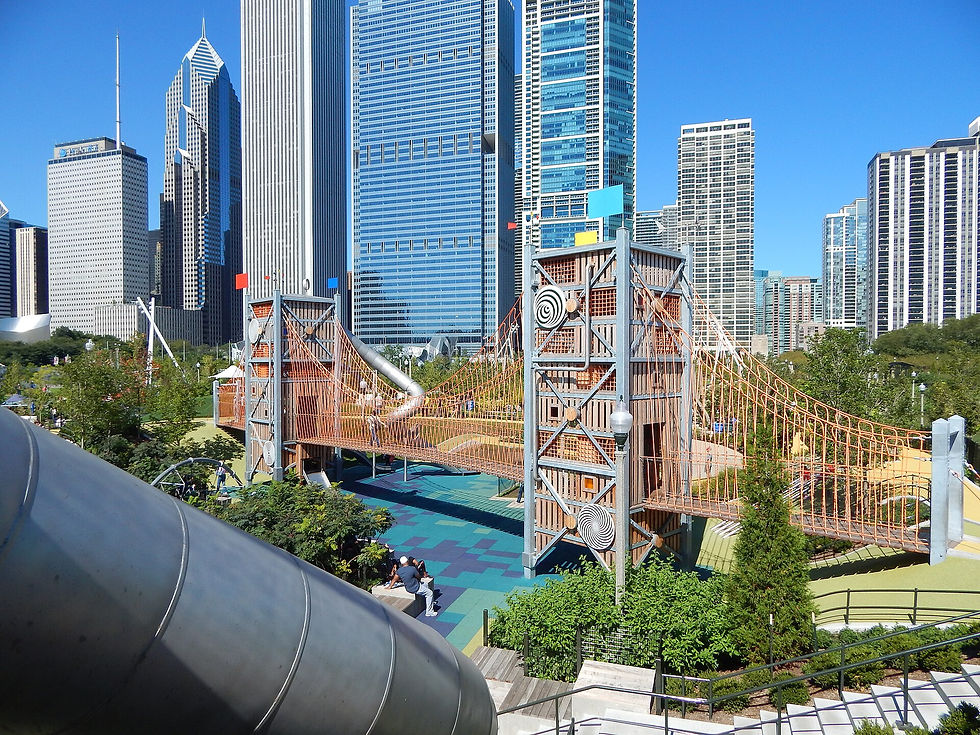
Figure 1. Monicaacosta34. Slide Crater Maggie Daley Park, 21 September 2015. Wikimedia Commons. https://commons.wikimedia.org/wiki/File:Slide_Crater_Maggie_Daley_Park.JPG . License CC BY-SA 4.0, https://creativecommons.org/licenses/by-sa/4.0/ .
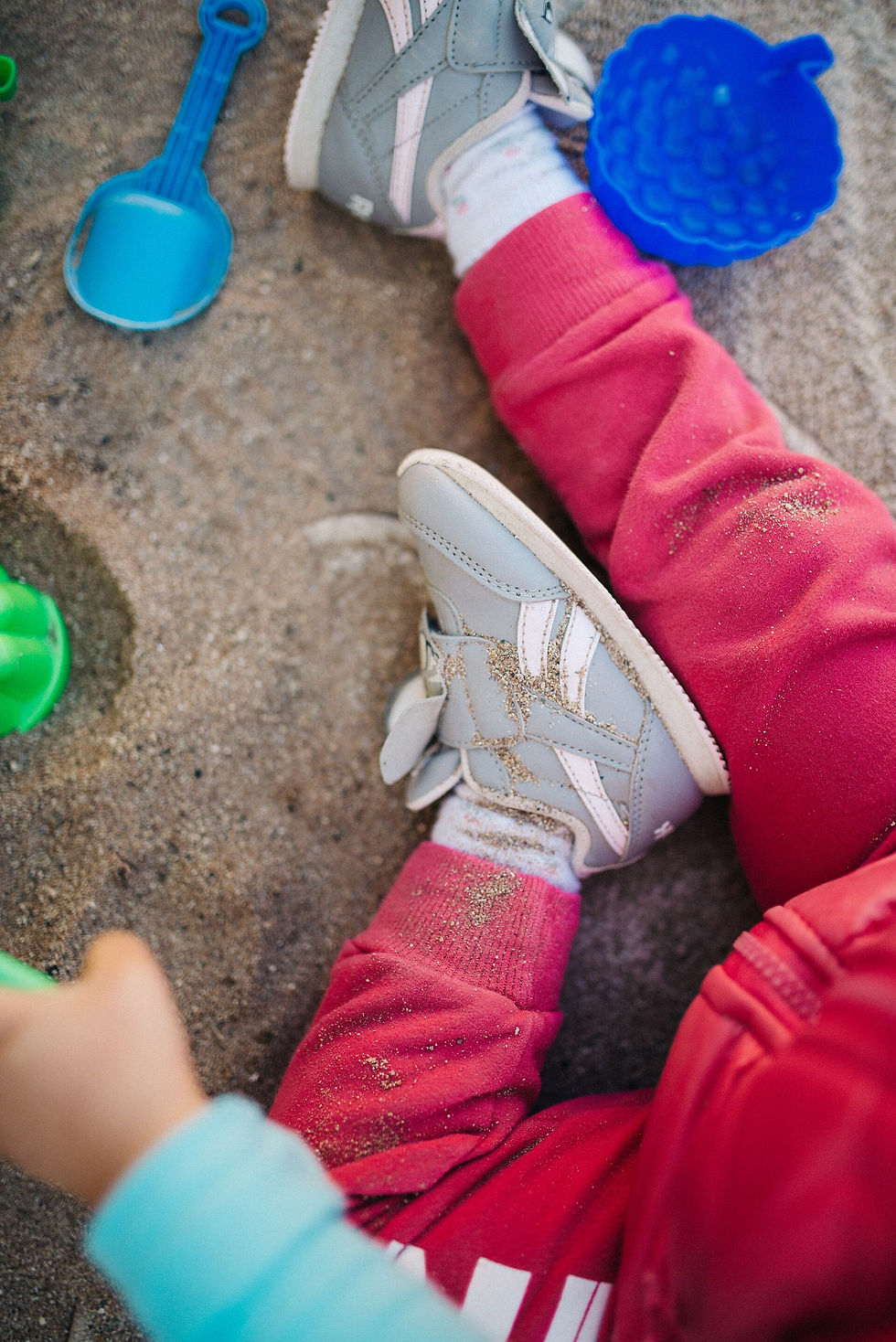
Figure 4. Shixart1985. Child playing in sand with colorful toys at a sunny playground during the afternoon, 8 April 2020. Wikimedia Commons, from Flickr. https://commons.wikimedia.org/wiki/File:Child_playing_in_sand_with_colorful_toys_at_a_sunny_playground_during_the_afternoon.jpg . License CC BY 2.0, https://creativecommons.org/licenses/by/2.0/ .
Figure 5. Leif Jørgensen. Trafiklegepladsen Fælledparken 08, 8 May 2013. Wikimedia Commons. https://commons.wikimedia.org/wiki/File:Trafiklegepladsen_F%C3%A6lledparken_08.jpg . License CC BY-SA 3.0, https://creativecommons.org/licenses/by-sa/3.0/ .
Figure 6. Sam Wilson. Wellington Square shade sail, 8 March 2026. Wikimedia Commons. https://commons.wikimedia.org/wiki/File:Wellington_Square_shade_sail.jpg . License CC BY-SA 4.0, https://creativecommons.org/licenses/by-sa/4.0/ .
Figure 9. Rhododendrites. Adventure Playground 11995a, 11 February 2018. Wikimedia Commons. https://commons.wikimedia.org/wiki/File:Adventure_Playground_(11995)a.jpg . License CC BY-SA 4.0, https://creativecommons.org/licenses/by-sa/4.0/ .
Figure 10. Paul Sableman. Chapman Adventure Playground at The Gathering Place, 21 December 2018. Wikimedia Commons, originally Flickr. https://commons.wikimedia.org/wiki/File:Chapman_Adventure_Playground_@_The_Gathering_Place.jpg . Original source https://www.flickr.com/photos/pasa/46474992231/ . License CC BY 2.0, https://creativecommons.org/licenses/by/2.0/ .
Comments